
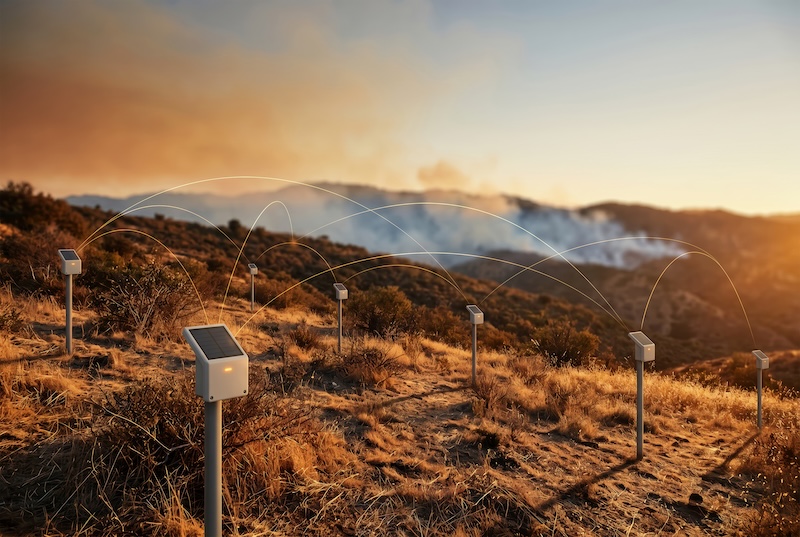
Wildfire seasons are becoming longer, more destructive and increasingly difficult to manage. Fire agencies now rely on a growing mix of technologies, including artificial intelligence (AI), drones, satellite imagery and Internet of Things (IoT) sensors, to improve situational awareness and coordinate resources. While these tools often receive the most attention, RFID is quietly playing an equally valuable role behind the scenes.
Rather than detecting fires directly, RFID helps incident management teams track personnel, equipment and supplies throughout wildfire operations. When integrated with IoT platforms and AI-powered analytics, it also improves operational visibility and decision-making.
Here are some of the key ways RFID supports wildfire management during fire season.
Tracking Firefighters and Emergency Personnel
Wildfire exposure now affects twice as many Americans as it did 20 years ago. The growing risk has increased the need for larger, more coordinated response efforts across complex fire zones. RFID helps incident commanders track firefighters and emergency personnel more efficiently, improving accountability and coordination throughout an incident.

Wildfire response often involves crews working across vast, ever-changing landscapes. RFID badges or wearable tags automatically record personnel entering or leaving designated areas. This reduces manual check-ins while helping incident commanders maintain accurate accountability throughout an operation.
Although many wildfire agencies continue to use GPS for broad location tracking, researchers are also exploring RFID-based asset tracking systems for wildfire operations. One project at the University of California, Los Angeles, combines RFID with mobile robots and machine learning to improve firefighter and equipment tracking in environments where traditional methods may be limited.
Improving Equipment and Vehicle Management
Wildfire operations depend on many critical assets, including hoses, pumps, chainsaws, radios, water tanks, portable shelters and protective gear. During fast-moving incidents, manually locating or counting equipment wastes valuable time.
Attaching RFID tags to firefighting equipment allows personnel to quickly verify inventory using handheld or vehicle-mounted readers. Crews can immediately determine whether essential tools are present before deployment and identify missing equipment after an operation.
RFID-based inventory systems can help fire departments verify equipment on fire apparatus more quickly than manual paper checklists. Agencies can also use RFID to manage personal protective equipment (PPE), making it easier to track assignments, inspections and maintenance throughout each item’s service life.
Supporting Equipment Maintenance and Readiness
Wildfire equipment operates under extreme conditions that accelerate wear and tear. Pumps, generators, breathing apparatus, radios and PPE all require regular inspections to remain reliable throughout the fire season.
RFID simplifies maintenance tracking by linking each asset to its inspection history, repair records and service schedule. Instead of searching through paper files, technicians can scan a tag to access maintenance information instantly.
This digital record helps agencies ensure safety-critical equipment receives timely servicing while reducing the likelihood that overdue or damaged equipment is accidentally returned to active duty.
Enhancing Situational Awareness Through IoT Integration
One of the biggest advantages of IoT is its ability to continuously collect and share real-time data across connected devices, giving emergency teams better visibility for faster, more informed decisions. RFID becomes even more valuable when combined with IoT platforms, GPS, weather data, satellite imagery and AI-powered fire behavior models.
Commanders can track the locations of crews and equipment while AI identifies resource gaps and recommends asset deployment. It’s also increasingly forecasting future staffing and equipment needs instead of simply analyzing past incidents. RFID provides accurate, real-time operational data that powers these AI-driven insights.
Rather than operating as a stand-alone tracking system, RFID strengthens the broader wildfire management ecosystem. As agencies continue adopting connected technologies, RFID supports faster decision-making, better coordination and more efficient emergency response.
Streamlining Wildfire Logistics
Wildfire response depends on a steady supply of fuel, food, medical resources and replacement equipment. RFID provides real-time inventory data, allowing response teams to monitor stock levels and track the movement of critical supplies throughout an incident.
Tagged shipments can be scanned as they arrive at staging areas or supply depots, giving logistics teams better visibility into available resources while reducing manual recordkeeping and the risk of misplaced inventory.
When integrated with cloud-based inventory systems, RFID data can also support AI-powered forecasting. This helps incident managers anticipate shortages, prioritize resupply efforts and allocate resources more efficiently as wildfire conditions evolve.
Challenges and Future Opportunities
RFID technology continues to evolve to meet the demands of wildfire environments. Ruggedized tags, mobile readers and AI-assisted tracking are improving performance across forests and other challenging terrain. As RFID becomes more closely integrated with IoT platforms and predictive analytics, it is poised to deliver even greater value for wildfire response, resource management and responder safety.
RFID Strengthens Modern Wildfire Response
Wildfire management depends on more than detecting and suppressing fires. Agencies must also coordinate personnel, equipment and supplies efficiently under rapidly changing conditions. RFID supports these efforts by providing accurate asset visibility and streamlining logistics throughout an incident.
As organizations continue combining RFID with AI, IoT sensors and predictive analytics, the technology will play an increasingly important role in building faster, safer and more resilient wildfire response operations.