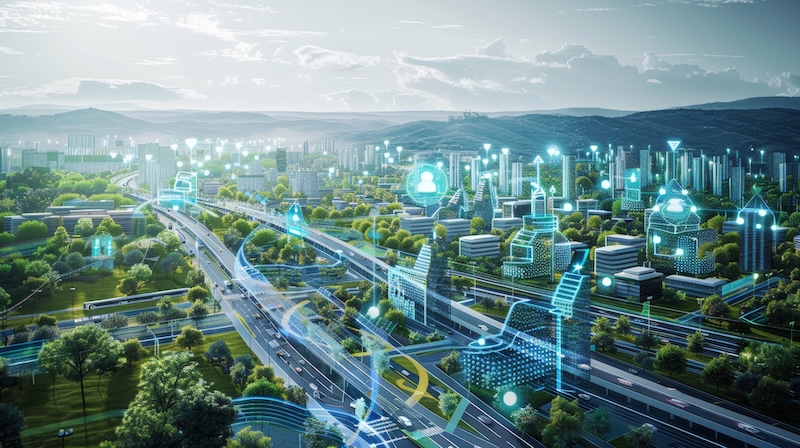
Driven by demand for more sustainable and efficient spaces, smart cities powered by IoT, artificial intelligence (AI), and 5G technologies are reshaping how residents live, work, and interact within urban areas across the globe.
The ‘smart city’ technology market is expected to reach $301 billion by 2032 as more cities look to boost their citizens’ wellbeing and safety, alongside improving resource efficiency and infrastructure quality.
The medieval city of Heilbronn in Germany is home to one of the world’s most advanced smart initiatives, where its “living lab” project exploits the power of event-driven integration to bring its smart campus to life.
Heilbronn Case Study
Heilbronn, located in southwest Germany, has always been one step ahead. It is not only known for its renowned wines and historical landmarks, but also for its forward-thinking approach to education, research, and technology innovation. The city’s Bildungscampus, opened in 2011, connects various educational and research institutions in one place, and includes Germany’s largest technology experience center for children. But Heilbronn is not just a city for students; it’s the launchpad for the next generation of AI pioneers with the aim of becoming the global home of humanized AI.

What truly sets Heilbronn apart is its “living lab” approach that allows real-world testing of smart technologies— from site operation robots to smart trash cans— and using its high-quality data to shape the future of sustainable urban living in smart cities.
Smart Cities: An Intersection of Innovation, Urbanization
Smart cities aim to improve all aspects of urban life, from traffic management, energy consumption, and citizen safety to healthcare delivery, resource efficiency, and infrastructure quality. Once a futuristic concept, research now suggests that nearly 90% of the U.S. population will be living in urban areas by 2050 with many expecting to experience smart setups.
Technology leaders are now on a tight timeline to keep pace with this growing demand. But given the sheer scale and complexity of urban systems, there are challenges to overcome. In particular, five key issues that, unless resolved, will damage the ability of smart cities to achieve their potential:
- Data silos. Traditional infrastructure often results in isolated data repositories, hindering holistic decision-making and the demand for instantaneous data processing and response
- Scalability. As cities grow and evolve, their data infrastructure must continuously scale to accommodate increasing demands
- Aging infrastructure. Outdated transportation, energy, and water systems can struggle to keep up with modern demand, leading to disruption and congestion. For instance, Atlanta, Georgia, experienced a state of emergency in 2024 following a massive water main break that left parts of the city’s downtown district without water and prompted a major hospital to transfer patients elsewhere
- Interoperability. Diverse systems and technologies must communicate effectively to create a truly integrated urban ecosystem
- AI. A huge leap forward from simple LLM applications, the use of AI in smart cities requires careful safeguarding of data privacy to address ongoing security concerns
From this, it can be seen that the need for a robust, scalable, and real-time data infrastructure is essential to success. This is where an event-driven integration platform, with event broker and event mesh capabilities, is uniquely positioned to be the core foundation for building truly smart cities.
So, let’s explore three uses cases from the Smart Campus Initiative in Heilbronn, Germany, to see where an event-driven integration platform is supporting some of the smartest and most cutting-edge developments.
Breaking New Ground with a Robot Facility Manager
At the Bildungscampus, an AI-controlled robot named Loomi has become a key member of the facility management team. Unaffected by weather conditions, Loomi autonomously moves around the campus on a fixed route defined by GPS coordinates, carrying out tasks such as checking air conditioning settings, bollard functionality, accessibility of escape routes, and lighting status.
When split-second decisions can significantly impact public safety, transportation, and service delivery, the ability to instantly distribute data between various systems as events occur and enable real-time decision-making is essential to the workings of a smart city. Loomi achieves this by using an event mesh to instantly communicate status updates and anomalies to relevant systems and personnel, enabling proactive facility management.
For instance, if Loomi detects a deviation with emergency routes, the robot can take an on-site picture and pass this information onto the team. They can then assess the need for action and initiate measures if necessary to solve the situation. It’s the perfect example of human-AI collaboration in action!
Sparking Efficient Energy Consumption Habits
Heilbronn’s campus buildings are equipped with sensor technology, with electricity, heating and water consumption used for energy management and ESG reporting.
Where traditional urban infrastructures feature isolated data repositories, Heilbronn uses an event mesh to establish connectivity directly via MQTT (Message Queuing Telemetry Transport). This enables efficient data sharing across different systems and supports the building automation by Neuberger that monitors and controls the heating, cooling, and electricity across the campus.
In the future, energy consumption will be optimized and tenants’ utility bills invoiced in real-time. The business impact is obvious— think cost savings, increased sustainability, and improved operations.
Twinning on the Vine
Another feat of the smart initiative is helping to enhance the city’s winemaking reputation. In different agricultural areas surrounding Heilbronn, long-range wide area networks (LoRaWAN) are being powered by the Things Network, a LoRaWAN network server that is connected and acts as a gateway via MQTT to the event mesh we have built.
The Things Network receives data such as humidity and temperature measurements, alongside rain and soil analysis, from sensors that are spread out across the various vineyard locations. The goal is to support winemakers in this region, helping them optimize yield, increase efficiency, and produce more cost-effectively.
A digital twin of two other vineyard locations has been built so soil conditions can be accurately represented in a geo-referenced manner by determining the phosphorus and potassium content, as well as the PH value. This means predictions can be made to optimize pest control, for example by detecting and preventing fungal infestation at an early stage.
Tapping Into Untapped Potential
Heilbronn’s three use cases only touch the surface of how an event-driven integration approach can support the creation of smart cities. Its ability to enable real-time data flow and integrate diverse systems means an event-driven platform is uniquely placed to scale up and adapt as urban needs evolve. So, what other smart city challenges can it overcome?
Scalability to support enormous data flows. Smart cities generate an enormous amount of data from IoT devices, sensors, and systems. The Heilbronn campus alone currently has 35.666 information points that provide the data needed for intelligent energy controls. This is where an event-driven integration platform is well equipped to handle millions of events per second, ensuring easy scalability as cities grow and more devices come online.
Security and resilience. Smart cities handle sensitive data ranging from personal information to critical infrastructure controls. An event-driven integration platform can securely transmit data and is resilient to outages – two factors that are paramount for maintaining public trust and ensuring the continuous operation of city services.
Edge computing capabilities. Many smart city applications, such as predictive maintenance of infrastructure or real-time traffic management, require processing at the edge. This is where an event mesh functionality enables edge computing, allowing data to be processed close to its source, and then transferred to the core for routing to other systems that process it. This reduces latency and ensures timely responses, which is critical for applications that can’t afford delays from centralized processing.
As illustrated by the Smart Campus Initiative in Heilbronn, the future of smart urban development lies in the intelligent integration of diverse systems and data sources. For technical leaders looking to embark on smart city projects, an event-driven integration approach is critical to unlocking the full potential of urban innovation and creating more livable, efficient, and sustainable cities for the future.