
Key Takeaways
- Halter is showing how solar-powered smart collars and LoRaWAN connectivity can replace physical fencing with real-time, remote cattle management across vast rural properties.
- The deployment highlights how low-power wide-area networks are helping scale smart agriculture by improving herd visibility, grazing efficiency and livestock welfare.
Cattle are often a farmer’s most valuable asset, yet keeping track of them and containing them across large, open grazing areas has traditionally relied on physical fencing and manual mustering, both labor-intensive, costly to maintain, and inflexible when pasture conditions change.
Farmers needed a way to move and monitor cattle remotely, in real time, across rural properties that often sit far from town with no reliable power or connectivity, without the capital cost and upkeep of new fencing infrastructure.
Halter is a New Zealand-founded agtech company that builds solar-powered, GPS-enabled smart collars for cattle, giving farmers and ranchers virtual fencing, herd monitoring and remote pasture management from a phone or tablet.
Halter Replaces Physical Fencing with Real-Time, Remote Livestock Management
Halter, founded by Craig Piggott on his family’s dairy farm in Matamata, supports collars deployed across New Zealand, Australia and the United States. The platform lets producers move, contain and monitor cattle without physical fences, cutting labor and improving grazing efficiency, animal welfare and land use, all while giving farmers back time previously spent on manual mustering and fence maintenance.

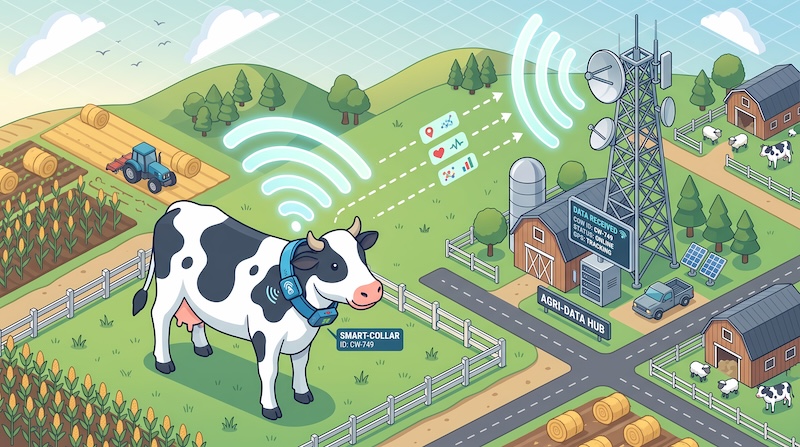
Halter built solar-powered, GPS-enabled smart collars that let farmers create virtual fences, move cattle, and monitor herd health and location in real time from a phone or tablet, removing the need for physical fencing.
Solar-Powered Smart Collars Gave Farmers Virtual Fencing, Live Herd Visibility
To keep that data flowing reliably across large, remote grazing areas, Halter’s system runs on LoRaWAN, using solar-powered gateway infrastructure and towers to maintain long-range, low-power connectivity across rural properties in Australia and New Zealand, without relying on mains power or mobile network coverage.
“LoRaWAN is a widely accessible LPWAN technology with a strong ecosystem and global adoption,” said Alper Yegin, CEO of the LoRa Alliance. “It can connect remote fields, moving herds, or entire estates, supporting a range of applications without the cost and complexity often associated with cellular, Wi-Fi, or Bluetooth.”
LoRaWAN Infrastructure Made Long-Range, Low-Power Connectivity Possible
With Halter’s collars running on LoRaWAN infrastructure, farmers across rural Australia and New Zealand have moved from manual mustering and fixed fencing to remote, real-time herd management, supporting better livestock tracking and healthier herds even in areas with no grid power or mobile signal. At a company level, Halter now reports more than 2,000 customers and over one million collars deployed across New Zealand, Australia and the United States.
This deployment sits within a wider LoRaWAN ecosystem for smart agriculture that spans livestock tracking, soil and irrigation monitoring, and perimeter fencing. LoRaWAN is an open, global connectivity standard maintained by the LoRa Alliance, with gateway hardware from providers such as RAKwireless supporting IoT solutions from small-scale projects to enterprise-level deployments.
“The opportunity in Smart Agriculture is to turn isolated fields into connected, intelligent environments,” added Yegin. “When environmental data becomes action, agriculture gets more productive, more sustainable and more resilient, at scale.”