
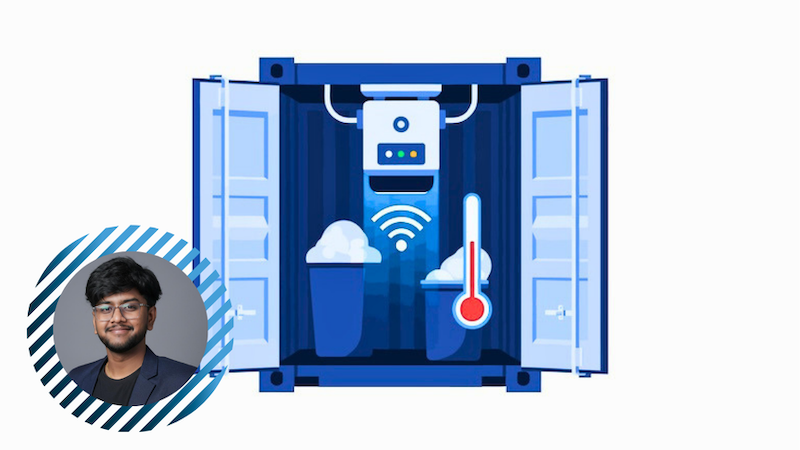
The industry narrative around IoT-enabled supply chain visibility in 2026 is compelling: Cat 1bis connectivity delivering global reach across 4G networks, BLE pixels broadcasting encrypted condition data from every shelf and pallet, AI platforms converting raw sensor streams into real-time decisioning. Digital Matter’s Loic Barancourt captured the direction well earlier this year: the most resilient IoT strategies now treat connectivity and location technologies as complementary layers, not standalone solutions.
He’s right. But there’s a layer missing from this picture and it’s the one closest to the physical world.
The Gap Between Visibility and Truth
Consider what “real-time visibility” actually means in a pharmaceutical cold chain shipment moving from a manufacturing facility in India to a distribution center in Europe.
The RFID tag is active. The BLE sensor is transmitting. The dashboard shows temperature, humidity, and location— updated every few minutes. The compliance record is being written in real time to a tamper-evident cloud platform. From every operational standpoint, the system is working exactly as designed.

Now consider what’s happening inside the shipment.
The product sat in an ambient-temperature staging warehouse at 41°C for three hours before loading. It spent 2.5 hours on a tarmac at Chennai International Airport (ambient temperature 38°C, direct sun exposure) while the reefer unit was being attached. During that window, the BLE sensor inside the thermal packaging was still transmitting. The readings were plausible. The dashboard stayed green.
But the sensor was reading the air temperature inside a packaging configuration that hadn’t reached thermal equilibrium with the product. The product surface temperature was 4.2°C higher than the logged reading during the peak exposure window. No alarm fired. The compliance record is clean. The exposure happened.
This is the gap that real-time tracking systems consistently miss — not a connectivity failure, not a platform failure, but a physical-world failure that no amount of improved tag density or connectivity coverage addresses.
Three Specific Failure Modes
- Logging interval averaging versus event capture
Most IoT monitoring systems used in supply chains are configured with sampling intervals of 5 to 15 minutes. Paessler’s David Montoya noted in RFID Journal’s 2026 Trends roundup that smarter IoT architectures now increase reporting during events like arrivals, handoffs, or temperature changes. That’s the right direction, but it hasn’t yet become standard practice in pharma cold chain monitoring.
A temperature excursion that peaks at 12°C for 22 minutes inside a reefer vehicle during a loading operation will be averaged across the surrounding 15-minute logging intervals and appear as a 2.1°C anomaly, well within alert thresholds. The excursion happened. The record doesn’t reflect it.
This is a logging architecture problem, not a connectivity problem. Higher-frequency event-triggered logging during known risk windows — door-open events, loading operations, tarmac dwell — is the engineering decision that changes what the record actually captures.
- Sensor placement and localized thermal zones
A single BLE sensor mounted on the inside wall of a reefer container measures the air temperature at that specific point. It says nothing about the temperature at the center of a pallet stack, behind a cardboard partition, or in the dead zone near the container door where temperature stratification occurs every time the door opens.
Wiliot’s Gen3 IoT Pixel— item-level sensing at scale— represents the architectural direction that addresses this limitation. When sensing moves from shipment-level to item-level, the thermal zones that single-point monitoring misses become visible. But between the current single-sensor majority and item-level sensing at scale, there’s an enormous installed base of shipments being monitored from one point in a thermally complex environment.
For pharma cold chain operators making procurement decisions today, the practical question is: how many sensing points does a shipment of temperature-sensitive biologics actually require to capture product-level exposure rather than air-level averages?
The answer depends on shipment geometry, packaging type, and transport mode— and it’s rarely the same answer the monitoring system vendor’s default configuration provides.
- The pre-loading blind spot
The most consistently undermonitored phase of a pharmaceutical export shipment is not transit. It’s the 3–6 hours before loading — when the product moves through ambient-temperature staging areas, sits in a freight station queue, and waits on a tarmac while logistics coordination happens.
Most cold chain IoT monitoring systems activate logging from the point of reefer truck departure or aircraft loading. The period before that, — in environments that can reach 40°C in Indian, Southeast Asian, or Middle Eastern origin facilities, is either unmonitored or monitored by facility HVAC sensors that measure room air temperature, not product zone temperature.
As RFID Journal’s 2025 IoT predictions noted, IoT sensors embedded in shipping containers, trucks, and warehouses will provide end-to-end visibility into shipment conditions. End-to-end is the operative phrase— and for pharma cold chains originating in high-ambient markets, end-to-end has to include the staging environment, not just the transit vehicle.
What Changes When the Data Is Regulatory Evidence
For most supply chain applications, a missed micro-excursion is an operational inconvenience — something to note and address in the next logistics review.
For pharmaceutical cold chains, it’s different. Temperature excursion data is regulatory evidence. Under 21 CFR Part 11 and WHO GDP guidelines, the monitoring record is a legal document. When an FDA investigator reviews a shipment’s temperature log and finds a clean record, they’re making a compliance determination based on what the sensor captured, not what the product actually experienced.
The gap between what BLE and RFID tracking systems log and what products physically experience during high-risk exposure windows is not a technology limitation that will be solved by more connectivity. It’s a system design question: are the sensing points, logging intervals, and monitoring activation windows configured to capture the specific failure modes of the specific supply chain they’re monitoring?
Most aren’t. They’re configured for the general case, deployed into a specific one, and trusted to produce a record that reflects physical reality. In low-ambient, well-controlled Western logistics environments, that trust is largely earned. In high-ambient, infrastructure-variable emerging market supply chains— where the fastest-growing volumes of temperature-sensitive pharmaceuticals now originate— it isn’t.
The Next Evolution of Cold Chain Visibility
The direction is clear. Item-level sensing, event-triggered logging, multi-point coverage, and extended monitoring windows that capture pre-loading environments— these are the architectural decisions that close the gap between operational visibility and physical-world truth.
The technology for all of this exists today. BLE, RAIN RFID, LoRaWAN, and ambient IoT platforms are converging toward exactly the dense, continuous, intelligent sensing layer that makes genuine end-to-end visibility possible. Avery Dennison’s $75 million investment in Wiliot signals where the industry believes item-level sensing is heading.
What hasn’t kept pace is the question of whether current monitoring deployments— the installed base running today across tens of thousands of pharmaceutical cold chain shipments— are actually configured to capture the exposure events that matter most.
That’s not a hardware question. It’s an implementation question. And it’s the one that determines whether “real-time visibility” is a genuine operational capability or a confident-looking dashboard over a gap the product already fell through.