
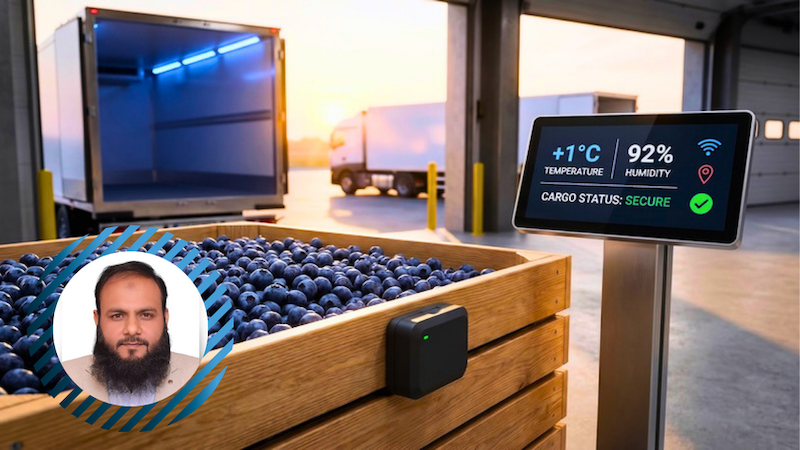
In most plants and logistics setups, cold chain control looks more solid on paper than it really is in practice.
You walk through a cold room, everything feels under control. Machines are running, pallets are stacked properly, and someone has signed the checklist. At that moment, it’s easy to assume the product is safe. But anyone who has worked long enough in food, pharma, or industrial storage knows this truth: problems rarely show up when you’re looking at the system. They show up later, when the product has already moved on.
A shipment gets rejected at the destination. A batch is downgraded. A customer raises a complaint. And then everyone goes back and tries to reconstruct what might have happened. That gap between what actually happened and what you can prove is where most cold chain losses live.
And it’s not only about temperature anymore. Humidity quietly plays its part in the background. Most people don’t notice it until packaging gets damaged, condensation appears, or shelf life starts dropping earlier than expected.

Why Temperature and Humidity Matter Together
Temperature is usually the first thing every operator watches. It’s simple and easy to understand. If it’s within range, people relax. But real cold chain behavior doesn’t work that simply. Humidity changes the picture completely.
For example, in a chilled meat storage room, the temperature might sit comfortably at 2°C all day. Everything looks stable. But during busy hours, doors open more frequently. Warm air enters, moisture builds up, and humidity slowly rises.
Nothing dramatic happens at the moment. But over days, condensation starts forming on packaging. Labels weaken. Cartons lose strength. Product quality quietly drops without any obvious alarm.
Focus on Pharma
The same thing happens in pharmaceutical cold rooms. Temperature remains within limits, but humidity spikes during loading and unloading. Moisture settles inside packaging layers. During audits later, this becomes a discussion point even if the product itself was never exposed to unsafe temperature.
Humidity also affects the system itself. Frost on evaporator coils doesn’t appear out of nowhere. It builds gradually when moisture is not controlled. That frost reduces airflow, which makes cooling less efficient. The system then works harder, consuming more energy, while the root cause remains hidden.
So in real operations: Temperature tells you if cooling is working while Humidity tells you if the environment is actually stable. Ignoring either one means you are only seeing half the picture.
How IoT Sensors Improve Cold Chain Visibility
Traditional cold chain monitoring is still very common in many facilities. It usually works like this: you place a data logger in a box, ship the product, and download the data at the end. The problem is simple. You only find out what happened after everything is already done.
If there was a problem in the middle of the journey, you see it too late to fix it. IoT sensors change this timing completely. Instead of storing data for later, they send it continuously while things are happening. That sounds small, but operationally it changes everything.
In real environments, different communication methods are used depending on the setup. RS485 is widely used in industrial cold rooms. It’s stable, works well over long distances, and handles electrical noise in factories without issues. Many engineers trust it because it behaves consistently. 4–20 mA systems are still found in older installations. They are simple and reliable but only carry basic signals. You get a reading, but not much context.
Modbus is common where SCADA systems already exist. It fits easily into existing automation setups without major changes. Wireless systems are used where wiring is not practical, reefer trucks, containers, and mobile cold storage units. Battery-powered loggers and cellular transmission are common here. Most modern setups actually combine all of these. Fixed sensors in cold rooms, wireless tracking in transport, and a central dashboard that brings everything together.
That is what makes true visibility possible not just one point in time, but a continuous flow of information.
Hardware and Integration Considerations for Plant Engineers
If you talk to plant engineers, they rarely complain first about sensor accuracy. They talk about placement. Because in real cold rooms, air doesn’t behave evenly. It moves differently depending on load, door activity, and how pallets are arranged. One corner can behave very differently from another.
That’s why cold-chain mapping is so important. Before final installation, engineers often run temporary sensor setups across different points in the room. They observe how temperature and humidity behave in real conditions, not theoretical ones.
Only after that do they decide where permanent sensors should go. And even then, compromises are always involved.
Wired systems are reliable but harder to install in existing facilities. Wireless systems are easier but depend on battery life and signal quality. High-accuracy sensors sound ideal, but in many cases, airflow and placement introduce more error than the sensor itself.
One sensor per room is simple, but it hides variations. Multiple sensors give better insight, but also more complexity. There is no perfect design. Only practical engineering decisions based on real constraints.
Data, Alerts, Continuous Monitoring in Real Operations
Having continuous data is not enough. What matters is how people use it. In well-designed systems, not every alert is treated the same way. A small drift in temperature might simply be a warning something to watch. It doesn’t always require immediate action.
A longer deviation becomes more serious because it suggests a real system issue. Humidity spikes are often early signals. They can indicate door openings, defrost cycles, or airflow disruption before temperature even changes.
But there is a practical challenge here. Too many alerts create noise. And when operators see too much noise, they start ignoring it. That’s why experienced teams focus on filtering. They group events, prioritize them, and only escalate what actually matters.
In real operations, usefulness matters more than volume.
Compliance, Audit Trails and Quality Systems
In regulated industries, everything eventually comes down to one question: can you prove it? Not just what happened, but when it happened and how it was handled. This is where IoT systems naturally fit well.
Instead of handwritten logs that depend on manual effort and memory, you get continuous records with timestamps. Temperature changes, humidity shifts, door openings, alarm events all recorded in sequence. During audits, this changes the entire process. Instead of trying to reconstruct history, teams can simply review it. You can see how conditions changed during transport. You can see exactly when a deviation started. You can also see how long it took for a response.
This level of traceability aligns well with HACCP in food manufacturing and GxP expectations in pharmaceutical environments. But the system is only as good as its discipline. Sensors drift over time. That is normal. Calibration is not optional; it is part of maintaining trust in the data.
That’s why validation steps like IQ, OQ, and PQ exist. They ensure the system is installed correctly, performs as expected, and remains reliable in real use.
Operational Impact on Waste, Energy and Capacity
The most obvious benefit of better visibility is reduced product loss. But the deeper impact often shows up in unexpected places. Once you start seeing environmental data clearly, patterns become obvious.
For example, frequent door openings during peak hours may cause repeated temperature fluctuations. That leads to more compressor activity, which increases energy consumption. Humidity buildup can slowly lead to frost formation on cooling coils. That reduces efficiency over time, even if temperature still looks acceptable on paper. Without visibility, these problems stay hidden. With visibility, they become fixable.
Over time, facilities usually see improvements in three areas:
- Less spoilage because deviations are caught earlier
- Lower energy consumption because systems run more efficiently
- Better planning because capacity limits become clearer
What surprises most teams is not the technology, it’s realizing how many inefficiencies were already there.
Practical Lessons for Manufacturers Deploying Sensor Networks
In most successful deployments, nothing starts at full scale. It starts small. One cold room. A few sensors. Enough to observe reality. From there, engineers learn quickly that placement matters more than specifications. A sensor in the wrong airflow zone will give misleading readings no matter how advanced it is.
Redundancy becomes important. Systems fail. Batteries drain. Signals drop. Good setups assume this will happen and design around it. Integration is another key point. Most facilities already rely on SCADA or MES systems. IoT systems should not replace them. They should add another layer of visibility on top.
And finally, the biggest change is not technical, it is behavioral. Once teams start seeing real-time conditions, they start making better decisions. That’s where the real value appears.
Final Perspective
Cold chain management used to be something you checked at the start and again at the end. Everything in between was assumed to be fine. IoT temperature and humidity sensors remove that assumption.
They make the “middle” visible. And once that happens, operations naturally become more controlled, more predictable, and far less dependent on guesswork.
Not because the system became perfect but because people can finally see what is actually happening inside it.