
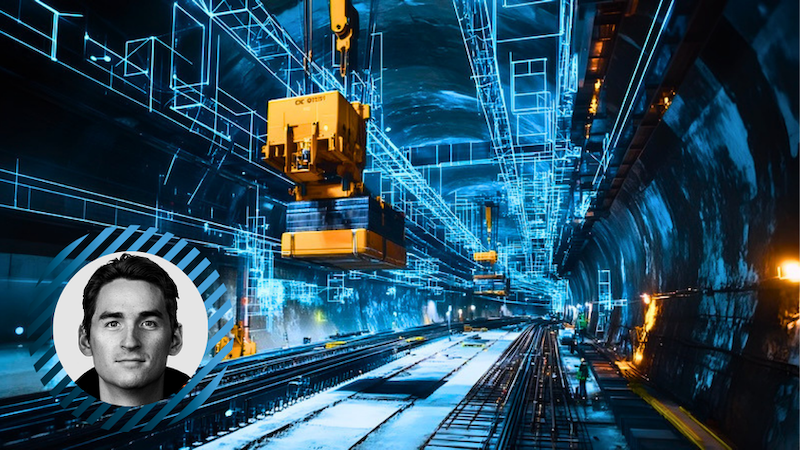
We have spent more than a decade getting very good at tracking the things that move through a facility. Pallets, totes, forklifts, and finished goods all generate a steady stream of location and condition data. Yet the overhead crane that lifts the heaviest loads in the building, often the single most consequential piece of equipment on the floor, usually generates none. It is one of the least instrumented assets in a modern plant.
That gap is starting to close, and it is worth paying attention to why. The technologies that connected the supply chain, real-time location systems, low-power IoT sensors, and RAIN RFID, are the same ones now moving toward fixed and semi-fixed lifting infrastructure.
The connected facility has a blind spot directly overhead, and the tools to fill it are already in this audience’s hands.
Why Lifting Infrastructure Got Left Behind
The crane was not skipped because it was hard to justify. It was skipped because it did not fit the model that drove early adoption. A few reasons stand out:

- It does not move through the building. Track-and-trace grew up following inventory from dock to shelf. A crane stays in its bay, so it never entered the track-and-trace conversation, even though what it lifts is often high value.
- It lived under a compliance mindset, not a data mindset. Cranes are governed by inspection intervals and safety standards, so they were treated as equipment to be certified rather than assets to be monitored.
- It was physically hard to reach. Instrumenting a bridge, hoist, and runway 30 feet in the air is a different proposition than tagging a carton on a conveyor.
None of those are technical barriers today. They are historical habits. RTLS itself followed the same expansion curve, moving from pallets to people to tooling and now to fixed assets, and cranes are simply the next logical stop. The recent formation of the Ambient IoT Alliance by companies including Qualcomm, Intel, and Wiliot signals how quickly low-cost, low-power sensing is expanding into places it never reached before.
RTLS: Position for the Crane and the Load
The first layer is location. The RTLS approaches this audience already knows can answer a question most facilities cannot currently answer in real time: where is the crane, and where is the load it is carrying?
Ultra-wideband and BLE positioning can track bridge and hook position with enough precision to matter on a busy floor. Newer low-power variants of ultra-wideband, the standard maintained by the FiRa Consortium, are pushing that precision higher while cutting the power budget, which makes persistent tracking of heavy equipment far more practical than it was a few years ago. Applied to lifting, that location data enables things like:
- Collision avoidance between multiple cranes sharing a runway or bay.
- Exclusion zones that flag when a suspended load travels over an area where people are working.
- A live activity picture of where lifting is happening across a facility, feeding the same dashboards that already show forklift and inventory movement.
The important shift here is that location becomes a safety control, not just an analytics feed. Knowing where a multi-ton load is in real time is operationally different from knowing where a pallet is.
IoT Sensors: From Scheduled Maintenance to Condition Data
The second layer is condition. This is where the crane maps almost perfectly onto a trend this audience already follows closely in cold chain and industrial monitoring: the move from scheduled checks to continuous, sensor-driven insight.
A crane is a collection of wear parts, hoists, motors, brakes, gearing, and wire rope, that degrade predictably with use. The same categories of sensor now common on pumps and production machinery apply directly:
- Vibration on motors and gearboxes to catch bearing and drivetrain wear early.
- Temperature on motors and brakes to flag overheating before failure.
- Load and usage-cycle counters to track how hard a crane actually works, which is the real driver of wear and the real basis for a maintenance interval.
Fed into an analytics platform, this turns a calendar-inspected machine into a continuously monitored one that can forecast a brake or hoist issue before it strands a load. Lifting equipment is a high-consequence, under-sensed candidate for exactly the predictive-maintenance approach the rest of the plant is already adopting.
RFID: Tagging the Rigging and the Record
The third layer is the one closest to this publication’s core, and it splits into two parts: the gear and the record.
On the gear side, below-the-hook rigging, slings, shackles, and hooks, has a defined inspection lifecycle and a habit of walking off between jobs. RAIN RFID tagging gives each piece an identity that can be scanned at inspection, tied to its rated capacity, and checked against its service history. That is the same item-level lifecycle logic being applied to tools and returnable assets across the industry, work the Auburn University RFID Lab and the RAIN Alliance have helped push into industrial settings.
On the record side, the opportunity is bigger. Overhead cranes carry a substantial compliance history, OSHA and ASME inspection results, load-test certifications, and repair logs, that today mostly lives on paper or in disconnected files. Linking a physical crane to its digital inspection and test record turns that history into queryable data and slots lifting equipment into the digital-thread and digital-product-passport conversation this audience is already having. It is worth noting that this works best when the equipment is engineered and installed with data capture in mind from the start, the way a modern jib crane installation can build in the mounting points and access that sensors and tags require, rather than retrofitting them later.
Where This Goes Next
The through line across all three layers is simple: the connected facility is incomplete while its lifting infrastructure stays dark. A plant can have full visibility into every carton and forklift and still have no live data on the crane moving its heaviest and most hazardous loads.
That will not last. The same forces reshaping the rest of the connected-asset landscape, cheaper sensors, ambient and battery-free IoT, maturing RTLS precision, and item-level RFID lifecycle tracking, all point toward the same destination. Over the next few years, expect crane and hoist monitoring to move from isolated pilots to standard practice, following the exact path that RFID and RTLS took through the supply chain.
The equipment doing the heaviest lifting has been among the last to get connected. For an industry that has spent years illuminating everything that moves, the machine doing the moving is the obvious next thing to bring into the light.