
For warehouse operators, the most useful question is no longer “barcode or RFID?” It is “which identification method removes the most friction from each process?” Treating the two technologies as competitors can lead to unnecessary redesigns. Treating them as complementary tools creates a more practical path to automation.
Barcodes remain highly effective in logistics. They are inexpensive, standardized, and supported by a huge installed base of scanners, printers, and warehouse applications. When an operator already handles an item and a deliberate scan confirms the next step, a barcode can be exactly the right tool.
RAIN RFID changes the economics when identification itself becomes the bottleneck. GS1 notes that RAIN RFID can complement optical barcodes and fill gaps where line-of-sight or individual scanning limits inventory productivity. Multiple tagged items can be captured within a configured read environment without scanning them one by one.
That difference matters, but it does not mean every barcode process should be converted to RFID.

Where Barcodes Still Make Sense
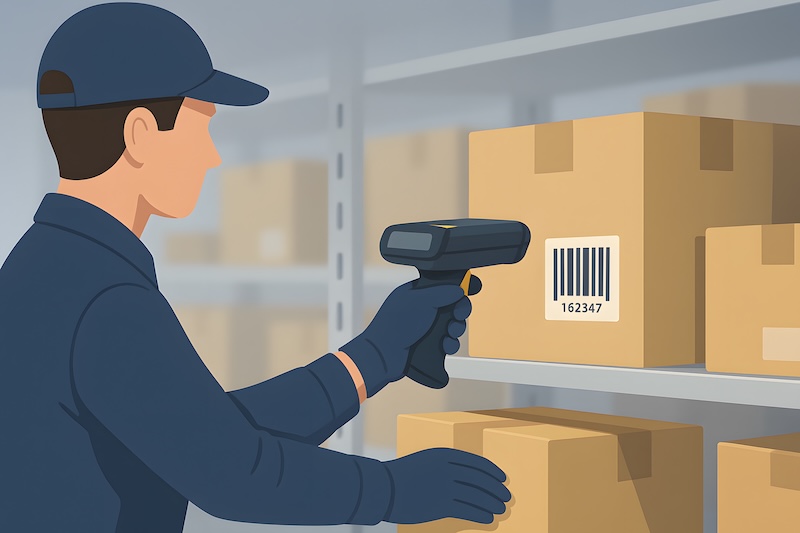
A barcode creates an intentional event. A worker points a scanner at a specific label and confirms a specific item, location, pallet, or task. That deliberate action is valuable in picking, exception handling, quality checks, and other workflows requiring precise confirmation.
Barcodes are also practical when products arrive without RFID tags, when item-level tagging would add cost without a measurable return, or when process volume does not justify fixed RFID infrastructure.
The move toward richer 2D barcodes makes this layer even more useful. Lot, serial, expiration, and other data can be captured within established scanning workflows.
Where RAIN RFID Changes the Workflow
RAIN RFID becomes compelling when a process spends too much time proving that objects are present.
Inventory counting is the clearest example. With barcodes, each label normally has to be presented to a scanner. With RAIN RFID, tagged items can be identified in bulk within the configured read zone. That can shift inventory from a scan-by-scan task toward a faster exception-driven process.
Receiving and shipping are another strong case. An RFID portal or controlled read point can verify tagged goods as they pass through a defined location. Instead of scanning every unit, the system can capture identifiers automatically and compare them with the expected shipment.
Reusable assets offer a similar opportunity. Totes, containers, tools, cages, and returnable transport items can be difficult to track because their value comes from repeated movement. RFID can make those movements more visible without requiring a manual scan at every transition.
Five Questions Before Choosing RFID
Before specifying readers, antennas, tags, or middleware, warehouse teams should ask five operational questions:
- How many items must be identified in the process?
- How much labor is spent positioning and scanning them?
- Does the process require intentional one-at-a-time confirmation, or is bulk identification acceptable?
- Is the physical environment suitable for reliable RFID performance?
- What measurable outcome would justify the investment: faster inventory, fewer shipping errors, better asset visibility, less manual handling, or higher throughput?
If those questions do not reveal a meaningful bottleneck, RFID may be technically impressive but commercially unnecessary.
The Business Case in Eastern Europe
For many Eastern European operators, the practical constraint is not whether RFID works. It is whether RFID can be introduced without rebuilding an otherwise functional warehouse.
Existing WMS and ERP platforms, mixed generations of mobile hardware, established label formats, supplier practices, and budget cycles all shape the decision. A brownfield site usually needs a selective approach rather than an all-at-once technology replacement.
That makes phased deployment valuable. A warehouse can begin with a process where the economics are easiest to measure—such as cycle counting, returnable asset tracking, or outbound verification—while preserving barcode workflows elsewhere.
The goal should not be maximum RFID coverage. It should be maximum operational improvement per unit of complexity introduced.
Design the Data Layer to Be Technology-Neutral
Hybrid identification works best when the business system cares about the identifier, not the capture technology.
GS1 standards provide a useful model: business identifiers can be represented across barcode and EPC/RFID systems. At the application layer, a WMS should ideally receive the product, asset, location, or serial identity it needs without requiring downstream business logic to care whether that identity came from a handheld barcode scan or an RFID read event.
This reduces technology lock-in and makes phased modernization easier. A company can introduce RFID at one dock door or inventory process without rewriting every barcode-driven workflow around it.
Start With One Measurable Bottleneck
The strongest RFID projects often begin with a narrow question: How long does a full inventory count take? How many labor hours are spent scanning returnable assets? How often does an outbound pallet reach the wrong lane? How much time is spent searching for tools or containers?
Measure the current process first. Then test whether RFID changes that metric enough to justify tags, readers, integration, training, and process controls.
A controlled pilot also exposes technical realities early. RF performance can be affected by tag placement, product materials, liquids, metals, reader geometry, and the physical environment. Testing those conditions before scaling reduces implementation risk.
The Hybrid Warehouse Is the Practical End State
The future warehouse is unlikely to be barcode-only or RFID-only. It is more likely to use multiple identification technologies according to the job.
Barcodes remain excellent where low cost, visual confirmation, interoperability, and intentional scanning matter. RAIN RFID adds value where bulk reading, non-line-of-sight capture, automated transitions, and higher process velocity change the economics.
The winning architecture is not the one with the most advanced technology. It is the one that gives each process the simplest identification method capable of meeting its accuracy, speed, visibility, and cost requirements.
For warehouse leaders evaluating RFID, that leads to a better starting point: do not ask what technology should replace the barcode. Ask which manual identification step is expensive enough to deserve automation.