
Artificial intelligence (AI) is now embedded across nearly every aspect of business. Organizations are using it to improve forecasting, support customer service, streamline administrative tasks and make day-to-day operations more efficient.
Yet the information powering these systems remains largely digital, with limited visibility into the real world. Vast amounts of useful data still sit within physical products, assets and environments, where it is difficult to capture. A shipment may travel through several stages of the supply chain without providing much information about the conditions it experienced along the way. Stock can move between factories, warehouses and stores, while businesses receive only occasional updates on its condition and whereabouts.
Closing this visibility gap will be essential if AI is to become more responsive and context-aware for real-world decision making. The next phase of its development will therefore depend on the ability to gather richer information from the objects and environments that surround us.
Bringing AI Into The Physical World
Physical AI is the term used for intelligence systems that can observe, interpret and respond to real-world conditions. Most familiar forms of AI operate within digital environments, with people interacting through a screen or software interface. Physical AI is able to extend these capabilities beyond the digital realm. It allows machines to gather information from their surroundings, assess what is really happening in situ, and take action as appropriate.

This is where the idea of the Internet of Everything (IoE) becomes a reality: where products and objects can identify themselves, share updates and provide useful data at different points within their lifecycle.
More advanced AI models alone won’t make this possible. For AI to understand the physical world in meaningful detail, it needs access to large swathes of real-time data, at item level.
Why Item-Level Intelligence Is The Next Frontier
Today, many AI systems only have a partial view of their physical operations. Data from inventory and the supply chain is often delayed, aggregated or incomplete. A business might know that a delivery has reached a distribution centre, for example, but doesn’t have any detail about the status of each individual product within it.
Item-level intelligence could radically change the status quo.
Connected products create a continuous flow of real-time information, helping organisations spot problems as they’re developing, understand where delays are occurring, and respond more quickly. Stock levels can be monitored with greater precision, product journeys can be followed more closely, and unusual activity can be identified before it becomes a larger issue. Decisions reflect current operating conditions rather than relying on historical assumptions.
This also creates new commercial opportunities. As regulations such as Digital Product Passports become more prevalent, demand increases for reliable information about provenance, sustainability and compliance across a product’s lifecycle. Accurate item-level data can help businesses meet those requirements, simplify reporting and create new value-add services built around real-time product insights.
Connected Intelligence At Scale
The challenge with connecting billions of objects is one of economic viability and scalability.
Traditional silicon chips are ideal for applications that require substantial processing power. However, they are often unsuitable for use-cases such as food packaging, shipping labels, clothing tags and other high-volume goods where cost, size and physical form factor are critical.
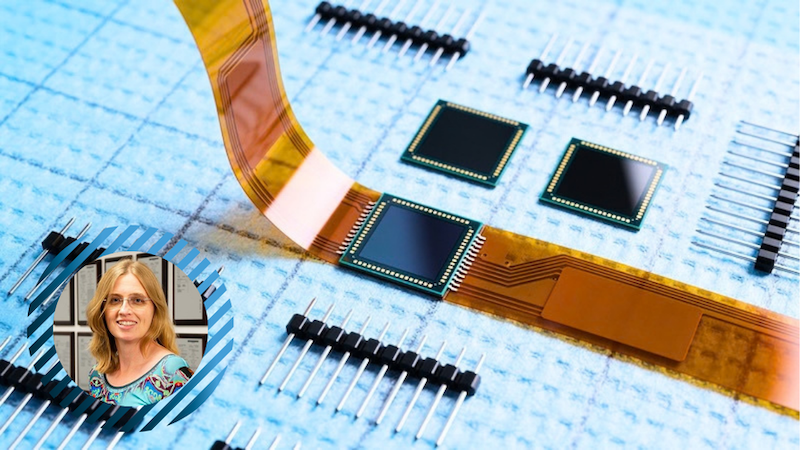
Flexible semiconductor technology is changing this. Their flexible form factor means they can be used on curved surfaces, opening new use cases for embedding intelligence in a cost-effective manner. Their simplified production process of just weeks also helps to reduce the environmental impact of manufacturing. This means they are particularly suited for sustainable applications involving recycling, reuse and circular economy.
This, in combination with their significantly lower cost, means they can now be used for applications that would previously have been too expensive to be viable.
Flexible electronics enable everyday products to become connected, creating a world where intelligence can exist almost anywhere. The result is a vast expansion of physical touchpoints capable of generating rich, real-world data for AI and digital systems.
A New Stage Of Digitalization
The future of AI won’t be shaped by a single technology. High-performance silicon processors will remain central to the demanding work of training and running advanced models. Data centres, cloud services and other digital infrastructure will continue to provide the computing capacity these systems will require.
Flexible semiconductors can support this ecosystem by extending intelligence to the edge of the physical world. Silicon chips provide the processing power; flexible chips provide the physical visibility. One enables AI to think; the other helps AI to ‘see’. Together, they create a new generation of intelligent systems that are directly connected to every item in the real world.
As AI becomes increasingly important to our businesses and economies, the organizations making the biggest advances will be the ones who can build the richest understanding of the real world. Flexible chips help bridge the gap between the digital and the physical. It’s this transition that will redefine efficiency across every industry in a global, AI-driven ecosystem.