
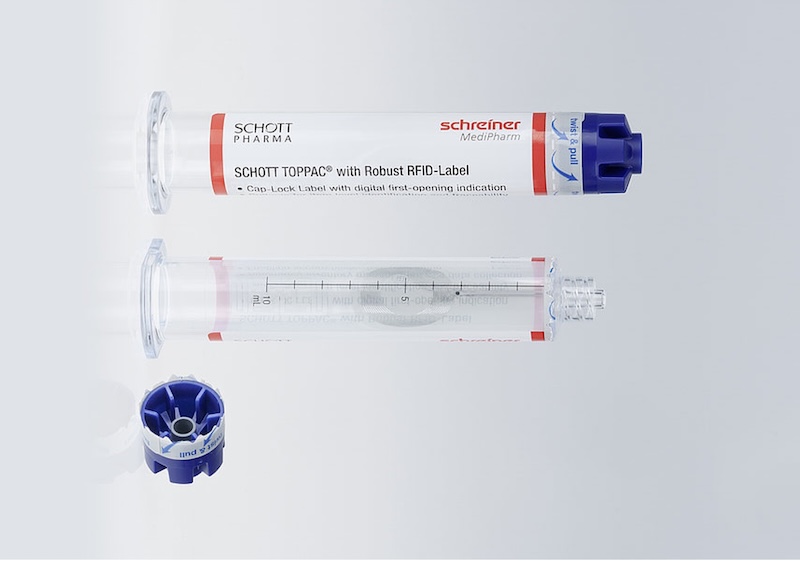
Schreiner MediPharm recently unveiled its new Cap-Lock Label with RFID functionality.
The new Cap-Lock plus RFID is based on the proven principle of Schreiner MediPharm’s Cap-Lock Label and will be presented in combination with Schott Pharma’s Schott Toppac infuse COC syringes.
The cap design has the same diameter as the syringe barrel with the Cap-Lock Label wraps around the syringe and cap. A label-integrated irreversible first-opening indication is activated as soon as the cap is opened. The solution safeguards the integrity of the prefilled syringe until final use, thus replacing the usual blister pack by a sustainable alternative enabling considerable carbon dioxide reductions and cost savings.
Schreiner MediPharm’s Product Integrity
Sebastian Muenscher, Senior Product Manager RFID/NFC Solutions at Schreiner MediPharm, said the solution is being offered due to the importance of product integrity and tamper evidence in pharmaceutical applications.

“Especially regarding containers such as prefilled syringes, it is crucial that the integrity of the drug container is ensured from production to the point of use,” said Muenscher. “Automation via RFID is state-of-the-art in North American hospitals. The new Cap-Lock Label with integrated RFID allows to add a digital tamper evidence and first-opening indication feature to the existing RFID infrastructure.”
RFID Solution
The special innovation of Schreiner MediPharm’s Cap-Lock plus RFID is its integrated RFID functionality. In addition to the analog first-opening indication, the chip embedded in the label offers a digital first-opening indication. In hospital settings, this enables automated tracking of the integrity of each individual prefilled syringe—up until the medication is administered.
Consequently, there is no need to manually check if the syringe has previously been opened, resulting in optimized and reliable processes for healthcare staff. Muenscher said this adds another layer of product and patient safety since it enables automated tracking of drug container integrity on unit level.
“Using label-integrated RFID enables a high level of automation to optimize processes and improve patient safety,” he said. “This includes bulk reading for real-time inventory management and digital documentation, a reduction of medication replenishment error rates and enhanced supply chain efficiency.”
Increased Safety
Due to optimized packaging and distribution processes as well as reduced space requirements during transportation and storage, it helps enhance efficiencies along the entire supply chain.
At the same time, clear identification on unit level is supported, which makes seamless tracking in the supply chain possible and facilitates automated inventory management in daily hospital settings. Expired drugs are automatically detected and unused prefilled syringes can be returned to inventory in a reliable process. Potential diversions and medication misuse can be monitored digitally.
As a result, pharmaceutical companies are provided with a reliable solution avoiding additional costs due to production downtimes and waste rates. At the same time, product and patient safety is enhanced. Additionally, it can be used with a software upgrade of the existing RFID infrastructure without any hardware change.
“The Cap-Lock Label with RFID functionality can easily be integrated into existing hospital inventory systems for unit-level traceability, expiry management, and diversion monitoring,” said Muenscher