
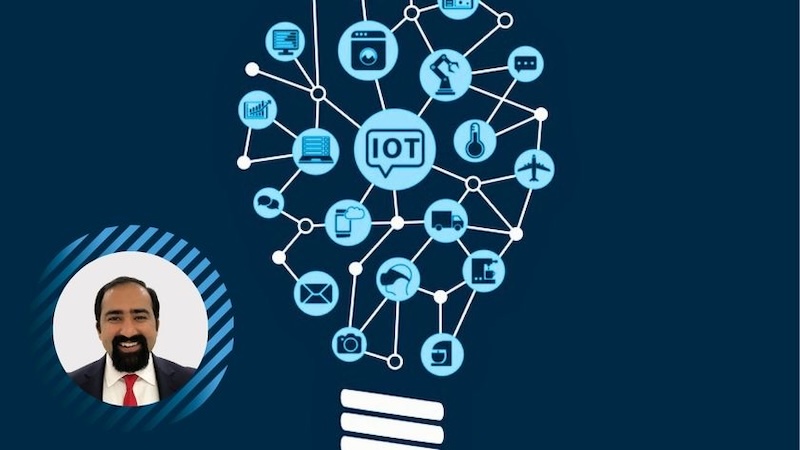
The Next Era of IoT Belongs to Intelligent Assets
For years, the promise of IoT has been about connectivity— sensors, devices, and systems that could communicate with one another. That promise has largely been realized. We’ve connected everything from medical equipment to machinery, vehicles to vending machines. But in 2026, the next wave of IoT won’t be defined by connection alone. It will be defined by intelligence and how data turns into insight, and how that insight turns into action.
Across industries, organizations are realizing that having connected assets is no longer a differentiator. What matters now is how intelligently those assets work together. What matters is how well they sense, learn, and adapt in real time. The future of IoT is about creating systems that think, not just systems that talk.
When it comes to predictions for 2026 we can only hope for the best. But what we hope is that we will see more advancements and uses for the technology, including these three predictions.
Prediction 1: IoT Will Move from Monitoring to Decision-Making
In its early stages, IoT was about visibility and knowing where things were, when they moved, or how they performed. In 2026, visibility will become table stakes. The next evolution is decision-capable IoT, powered by AI models that analyze sensor data and act autonomously when thresholds are crossed.

Imagine a network of medical devices that automatically reschedules service when usage patterns shift, or a fleet of vehicles that dynamically reroutes based on fuel efficiency and predicted maintenance needs. This isn’t speculative— it is already happening in isolated systems. Over the next year, those capabilities will scale, as organizations learn to trust algorithmic decisions and design governance models that balance human oversight with AI autonomy.
The shift from monitoring to decision-making will not only improve efficiency but also reduce downtime, minimize human error, and strengthen safety and compliance. The intelligence layer sitting atop IoT will become the invisible engine of operational reliability.
Prediction 2: Ambient IoT Will Bring Intelligence Everywhere
Until now, IoT deployment has been limited by infrastructure. The devices needed power, bandwidth, and connectivity. The rise of ambient IoT will change that equation. Advances in ultra-low-power sensors and energy-harvesting technologies are making it possible to embed intelligence almost anywhere, from shipping materials and medical packaging to tools, safety gear, and industrial components.
These micro-sensors will extend real-time awareness to objects that were previously untrackable. The result will be a shift from selective monitoring to continuous intelligence, where data is automatically captured across the value chain without manual input or expensive infrastructure.
For business leaders, this means a new level of operational precision. Supply chains, hospitals, and construction sites will be able to understand not just what’s happening, but why it’s happening, and what to do next.
Prediction 3: Asset Intelligence Will Become a Strategic Function
As IoT and AI converge, a new category of enterprise intelligence is emerging called asset intelligence. This is the ability to understand, predict, and optimize how every piece of equipment, device, or system contributes to business outcomes.
In 2026, this intelligence will move from the operations layer to the strategy table. Business leaders will treat asset data as a source of competitive advantage, not just maintenance efficiency. They will ask questions like, “which assets deliver the highest ROI; where can we automate to unlock capacity or; how can we align maintenance, procurement, and sustainability around the same real-time insights?”
The result will be smarter capital decisions, tighter alignment between finance and operations, and a measurable link between technology investment and enterprise performance.
From Visibility to Value
Technology alone doesn’t create transformation — process discipline and strategic alignment do.
In the coming year, organizations that see success won’t be the ones with the most connected devices, but the ones that turn data into decisions and decisions into measurable value. IoT’s next chapter is about making every digital or physical asset contribute meaningfully to business goals.
The era of intelligent assets has begun.