
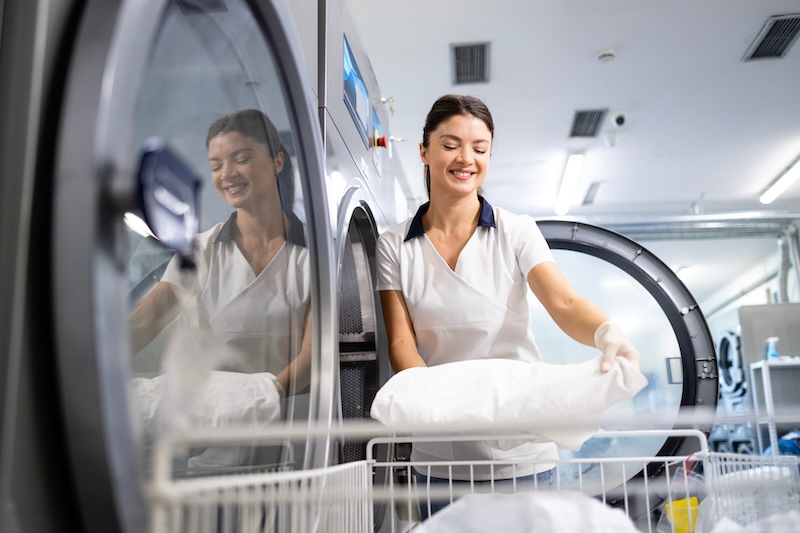
Essential Healthcare runs a high-volume equipment hire and decontamination operation, processing more than 12,000 mattress systems and other medical assets each year for healthcare providers across the UK. Each mattress system comprises multiple components— base cover, top cover and inner mattress— alongside pumps and bariatric equipment, all with different handling procedures service schedules and compliance requirements.
The company relied on manual, paper-based records at every stage of the decontamination process, documenting asset IDs, cleaning steps, technicians and quality checks by hand. This approach met basic requirements but made it difficult to provide robust, item-level traceability at scale, slowed throughput in the decontamination center and increased the risk of weak audit trails.
Essential Healthcare wanted to transform asset management and compliance tracking: they needed a way to follow each individual asset through its entire lifecycle— from delivery, to use on the ward, to decontamination and back into the rental fleet— without manual data entry at every step. They considered barcodes but recognized that labels would not survive industrial washing cycles reliably and looked at active RFID and mobile-based tracking before concluding that signal limitations in older hospital buildings and battery maintenance requirements made those options impractical.
CoreRFID Partnership
To achieve their goals, Essential Healthcare partnered with CoreRFID to design and supply a passive RFID tagging solution tailored to equipment hire operations and industrial decontamination workflows.

CoreRFID works with clients to integrate RFID hardware into existing business systems, improving traceability, compliance and operational efficiency without forcing wholesale software change. The company specializes in passive RFID solutions for complex asset tracking and identification across equipment hire, logistics, manufacturing and industrial sectors. CoreRFID combines consultancy, hardware sourcing and system design to help organizations specify the right tags and readers for demanding environments, from industrial laundry to harsh outdoor sites.
RFID Tagging Program
For Essential, CoreRFID specified passive UHF RFID tags in two formats to match different asset types: laundry-compatible tags, rated for industrial washing cycles up to 85°C, for mattress covers that pass-through washing machines, and durable label tags for pumps and bariatric equipment. Both tag types operate at 860-960 MHz and comply with ISO 18000-6C, ensuring consistent performance with handheld readers in a challenging environment that includes moisture, metal and dense loads of textiles.
Additionally, CoreRFID supplied TSL handheld RFID readers, enabling staff to scan tags at key points in the workflow without line-of-sight and without depending on mobile network coverage inside hospital or decontamination facilities. Each asset now carries a unique identifier that links directly into Essential Healthcare’s bespoke software; when a mattress system returns from a hospital, staff scan automatically updating status and triggering quality checks. At the final assembly stage, staff scan three tags – base cover, top cover and inner mattress – and the system verifies that every required decontamination and inspection step has been completed before the equipment can be dispatched.
CoreRFID’s consultancy role focused on selecting the right tag formats to survive industrial laundering, optimizing read reliability within the workflow and designing a practical, scalable RFID infrastructure that could be integrated into Essential Healthcare’s existing systems without replacing their bespoke software.
Operational Results
The RFID implementation delivered immediate and measurable operational gains. Asset tagging time was cut by 50%, from three minutes per asset to just 90 seconds, transforming a previously manual bottleneck into a streamlined, largely automated step.
Across 12,818 systems per year, with typically three assets per system in the decontamination process, this equates to around 16 minutes saved per system and 3,418 hours saved annually – approximately 950 working days. Staff who previously spent large portions of their day writing down asset numbers and completing paper certificates can now focus on core decontamination and quality activities. The RFID-enabled workflow also functions as an automatic quality gate: if any required step has been missed, or if an item is flagged for repair, the software will not allow the mattress system to be assembled and dispatched.
As Essential Healthcare’s IT & Business Systems Support lead Lucy Mathie notes, “If all the steps haven’t been done, when you try to assemble it, the system won’t let you. Incomplete or improperly cleaned equipment can’t be dispatched to customers.”
Positives of Passive RFID
Beyond time savings, the tags underpin Essential Healthcare’s rental operations by enabling accurate per-asset invoicing, detailed utilization reporting and full lifecycle traceability that would not be feasible with manual methods. “In terms of rentals admin, I don’t think I can’t quantify it. There’s no way to replicate this process via a manual method,” Lucie explains. “We would not have accurate invoicing, reporting or traceability.”
Richard Harrison, Technical Director at CoreRFID, summarizes the deployment: “This is a good example of what passive RFID delivers in a high-volume, compliance-critical environment. The practical challenge here was matching the right tag format to each asset type – particularly specifying tags that survive industrial washing cycles reliably. Once that’s right, the time savings and traceability improvements follow.”
This project highlights how passive RFID can unlock new capabilities for equipment hire businesses beyond basic decontamination traceability. The same tags that support washing and quality control also feed rental-side analytics, enabling Essential Healthcare to track rental performance, monitor turnaround times, log repairs back to the correct departments and provide customers with detailed utilization statistics for each asset.
By choosing a passive UHF solution, Essential Healthcare avoided the signal limitations and battery overheads associated with active systems in older hospital buildings, while still achieving item-level visibility across thousands of assets. The deployment demonstrates a replicable model for other equipment hire providers seeking to move from manual, paper-based processes to RFID-enabled automation, while retaining their existing software platforms.