Pharma RFID Adoption Still Slow
A survey by Health Industry Insights shows few drug makers and distributors are implementing the technology, or even evaluating it.

A survey by Health Industry Insights shows few drug makers and distributors are implementing the technology, or even evaluating it.
A new crash detection system features RFID tags and sensors that can sense impact, determine its severity, and report the incident to monitoring units up to 250 meters away. The monitoring units automatically report serious crashes to authorities using either wireless mesh networks, CDMA, GSM, or other wireless communication.

The news that T3Ci has analyzed more than a billion tag reads indicates that volumes of tagged goods in the retail/CPG supply chain are starting to rise.

New encryption techniques promise to make the use of RFID applications more secure, increasing the public’s trust in the technology.
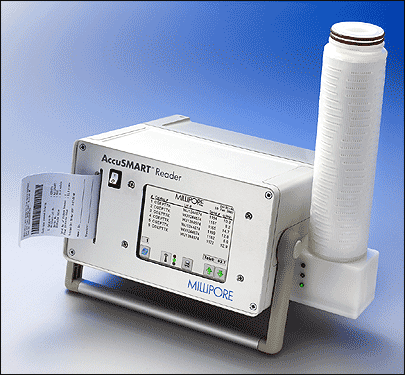
Millipore will begin selling filtration products with integrated RFID technology to allow its drugmaker customers to access data about a filter’s test performance.
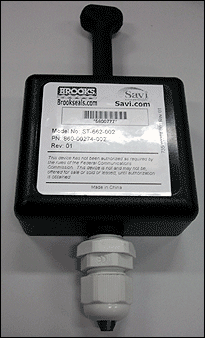
The manufacturer’s hard drives are moving through government inspections more quickly and efficiently thanks to an RFID-based security and verification system.

A research project supported by government funding has generated a device with potential use in a range of applications, such as mapping archeological sites.
N.D. bans RFID implants, Calif. senate approves school ID bill; MachineTalker offers sensor networking kit; PINC raises $4.5 million in funding; Sirit AVI reader ready for Europe; Midwest stadiums score RFID payment terminals; Gemalto ID card certified for government ID use.
Baird has released its April report. The 16-page document is a worthwhile read for anyone requiring an overview of the industry’s last 30 days. For those without time to do so, we have reprinted here the report’s summary.
The company says the milestone shows RFID adoption is growing.