
Consumer IoT is growing fast. Connected features are moving from niche gadgets into everyday products like wearables and smart devices, and brands are under pressure to build in intelligence and interactivity that works at mass-market price points.
That ambition runs into a supply reality. A connected world needs an enormous number of chips, yet many everyday applications don’t require the most advanced silicon used in phones or autonomous vehicles; they depend on mature, legacy nodes. Scaling legacy production is difficult. Older tools are harder to source, new fabs demand eye-watering investment and long build times, and sustainability expectations keep rising as energy and water usage come under closer scrutiny.
Even where capacity exists, traditional silicon manufacturing still brings long lead times and cost constraints. If the goal is affordable, ubiquitous intelligence across billions of items, the industry needs manufacturing that can scale faster and more efficiently, which points to a fundamentally different approach to semiconductors.
Flexible Semiconductors, Built for Scale
Enter flexible semiconductors: a transformative technology poised to redefine what’s possible for the Internet of Things (IoT).

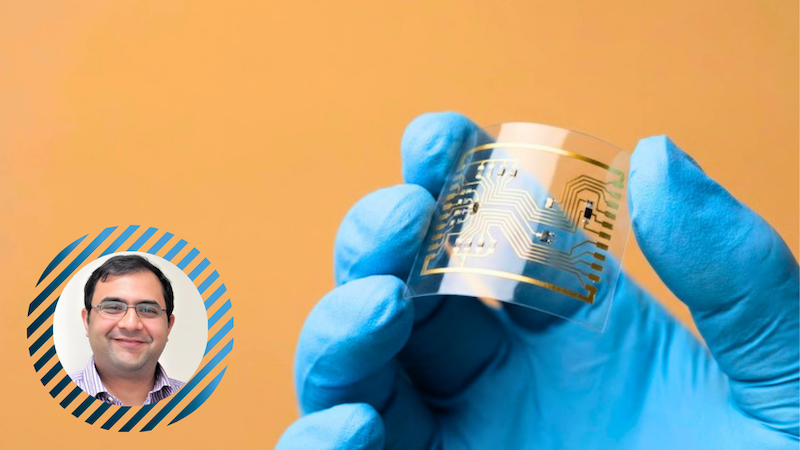
Unlike silicon chips, these semiconductors use thin‑film transistor technology and low‑temperature, resource-efficient‑ production methods. Silicon requires hundreds of process steps, some at thousands of degrees Celsius, to achieve the ultra-pure state required for microchips. By contrast, flexible chips use a simple substrate of polyimide and 30-40 process steps, the majority at ambient temperature.
New Class of Intelligence
This naturally consumes far less energy and water, and fewer harmful chemicals, making them more sustainable and more cost effective to make. It also makes the fabs used to create them smaller— and so quicker and more cost-effective to deploy.
This unique production method dramatically shortens production timelines, too, cutting development cycles from months to weeks. Lower set-up costs make customization— and rapid iteration— economically viable, empowering design teams to move fast and experiment freely.
And because the chips are ultra-thin and physically flexible, they can be imperceptibly embedded in products or packaging, even on curved surfaces. These unique advantages of cost, form factor and carbon footprint have created a new class of intelligence that’s more sustainable, more scalable— and takes smart functionality to new spaces.
Taking NFC Beyond Premium Use Cases
NFC has already proven its value in areas such as contactless payments, secure access and authentication of goods. Now, brands are increasingly using NFC to unlock richer consumer experiences. But its adoption has largely been limited to high-value goods or reusable devices, due to the cost— and environmental credentials— of conventional silicon chips.
Flexible NFC chips, however, remove those barriers, making it commercially viable to bring smarter interactivity to mass-market products, unlocking item-level intelligence at scale.
Sectors such as food and beverage and FMCG have long struggled to connect directly with consumers at the point of use. Packaging is often discarded, and engagement ends at checkout. But by embedding flexible chips directly into products, brands can open a digital channel that persists throughout the product lifecycle.
Added Value for Consumers
Consumers simply tap their smartphone to the pack to access instructions, promotional offers, refill services or loyalty programs. This drives brand engagement, gathers usage data and supports more personalized marketing— all without requiring an app download. And because these chips are cost-effective and easy to integrate, this can be done across entire product lines.
Think of a pair of trainers that carries a unique digital identity, loyalty rewards tailored to location or season, or packaging that guides consumers through recycling. With flexible NFC chips, these applications are not futuristic concepts, they are a reality.
Once you unlock ubiquitous, scalable intelligence, every interaction becomes an opportunity. For consumers, this adds value and transparency. For brands, it means richer engagement, better data, and deeper customer relationships throughout the product lifecycle.
More than Engagement
Flexible chips also have the power to tackle persistent challenges like counterfeiting and transparency.
Counterfeit goods cost global brands billions each year and undermine consumer trust. Existing authentication methods are often easy to forge or expensive to implement. But a flexible NFC chip can provide each product with a secure, embedded, unclonable identity.
This allows consumers, inspectors and supply chain partners to instantly verify authenticity, or provide instant access to a digital product passport (DPP), so customers can trace a product’s history and make informed choices. Brands, meanwhile, gain full visibility into where and when their products are being scanned.
The technology also extends to the circular economy. These chips can underpin intelligent deposit-return schemes for reusable packaging, incentivizing recycling while giving manufacturers insight into product lifecycles.
Preparing for a flexible future
As consumer IoT continues to expand, the need for low-cost, high-volume connectivity will accelerate. Item-level intelligence is becoming a foundation for a more connected, transparent ecosystem, where products can share insights and enable more sustainable habits.
Flexible NFC makes that practical at scale, reducing cost and integration friction while lowering environmental impact, and bringing always-on interactivity to everyday products.