
In the aftermath of COVID, ensuring that both in store and online customers have the same availability has been a priority for retailers worldwide with RFID right at the center for those solutions.
BIG W is one of Australia’s most loved brands, offering great value for families across the country. With a national network of stores and a growing digital presence, BIG W provides a wide range of general merchandise, including clothing, footwear and home products.
BIG W’s Clothing and Footwear operations are committed to making shopping easier for customers by ensuring the right products are available on the shelf and online when families need them most. “RFID has changed the game in clothing, it allows us to more easily deliver on our promise to our customers on great availability on the products they love, whilst teaching us things about our business we’ve not had clarity on before,” said Dan Hake, Managing Director, BIG W.
Big W’s Transformation
Woolworths Group is one of Australia and New Zealand’s largest retail ecosystems. Within the group, Woolworths 360 & Group Enablement teams focus on leveraging retail innovation and technology to optimize supply chain efficiency, store operations and customer experience.

Recognizing that size level gaps are a friction point for customers, Woolworths Group introduced an RFID solution to ensure that whether a customer shops in store or on their app, the perfect fit is always within reach. By developing and deploying scalable solutions like RFID, the retailer empowers their brands to deliver on availability promises and operational excellence.
Solving RFID Tagging Issues
A major hurdle during implementation was tag saturation. When engaging suppliers on source tagging for new season products, it was estimated it would take up to two years to naturally clear non-RFID stock from the supply chain. BIG W did not wait that long for improved availability, which created a unique operational problem: residual tagging.
With RFID technology, finding a tagged item is easy, like using a magnet to find a needle. However, finding the non-tagged product (among thousands of items, some of which are tagged and some are not, requires manual inspection. BIG W’s leaders wanted to find a way to isolate, scan and print tags for every single non-seasonal product to reach 100% saturation and activate the RFID inventory routines.
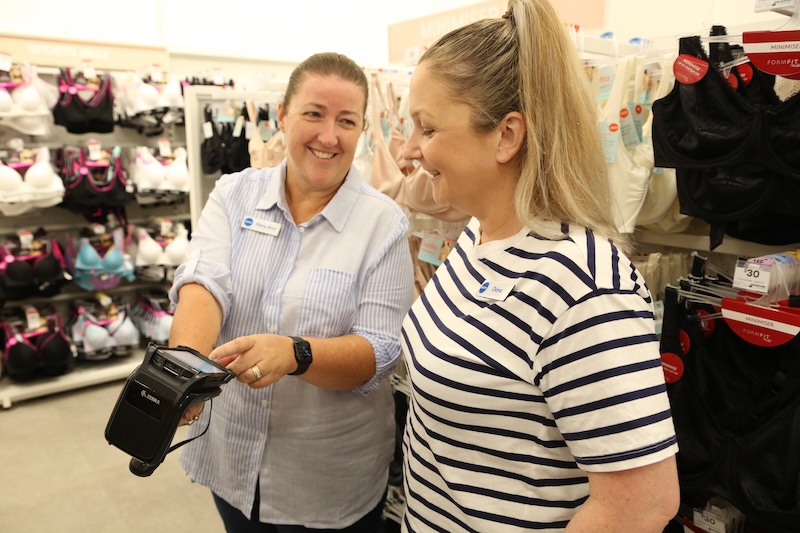
To move at speed, the company partnered with Checkpoint as a strategic tag partner to co-manage supplier engagement and tag selection, while GS1 and Auburn University ensured correct EPC standards and certifications. Sensormatic provided the in-store software that allowed BIG W to test and learn rapidly and scale at speed, and expanded their partnership with Zebra for RFID hardware.
Program Benefits
To solve the immediate tag saturation challenge, BIG W invested heavily in residual tagging rather than waiting for stock turnover and worked with Crew Services to rollout a manual tagging program across 180 stores in just months. This involved teams inspecting every item, isolating non-tagged products and applying tags on site.
Once the stores reached full tag saturation, a new inventory routine was activated. Because RFID is an invisible technology, the retailers focused on change management, providing clear guidance to teams on scanning techniques, safety and efficiency to ensure they understood exactly what to scan and when to stop to avoid over scanning.
“Turning on the hardware is the easy part; adopting the technology and the insights is the real journey,” said Stephen Macpherson, Senior Product Owner RFID & Co-Chair RFID Coalition Australia. “The breakthrough doesn’t come from the tags, it comes from a team that learns to trust the data and turn that into actionable insights that will affect real business change.”
The impact of the RFID rollout was immediate. By solving the manual search issues, accelerating tag saturation, and correcting inventory weekly with RFID cycle counts, BIG W has achieved the following:
- Team Experience: It is better for our team who can now count quickly, locate items and deliver on our customer availability promise consistently.
- Customer Satisfaction: We are seeing these operational wins translate into positive customer feedback regarding product attainability.
- Improved Availability: We have seen a measurable improvement in on shelf availability for both brick and mortar shoppers and online fulfillment.
- Sales Growth: The improved size level accuracy has directly translated into sales growth, as customers can now find the specific sizes they need.
“The success of the BIG W rollout demonstrates that with the right ecosystem, retailers can solve complex legacy inventory issues,” said BIG W’s Hake.
Global Impact
Woolworths Group’s team noted the project highlighted the importance of collaboration as they leaned heavily on their partners — Checkpoint, Sensormatic, Zebra, Crew Services, GS1, Auburn University— and global peers for support.
“A transformation of this size cannot be done in a silo,” said Darren Rowan General Manager, IT – Stores Digital & W360. “Bringing this technology to life across our stores relied entirely on the collaboration, guidance, and expertise of an incredible network of partners.”