
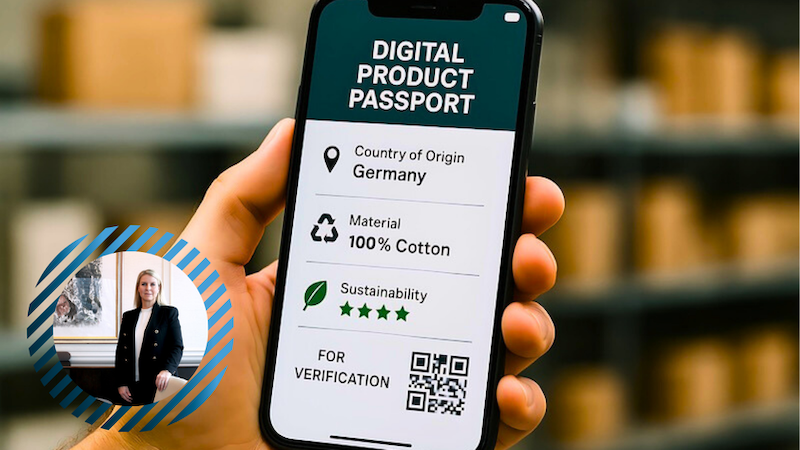
RFID and Digital Product Passports: Two Systems, One Goal— Traceable, Trusted Products
As the apparel industry prepares for the European Union’s upcoming Digital Product Passport (DPP) regulation, the conversation is shifting from logistics to longevity— from knowing where a product is to understanding what it is made of, how it is used, and where it goes next.
For two decades, item-level RFID has been the silent engine of retail efficiency— driving inventory accuracy, reducing waste, and enabling real-time visibility across complex supply chains. It is, at its core, a business-to-business technology built to ensure that every item can be counted, tracked, and verified.
DPPs will extend that principle far beyond the walls of retail. Designed to follow a product throughout its entire lifecycle, DPPs will capture and share data on materials, environmental impact, repair instructions, and recycling options— connecting brands and retailers, consumers, regulators and recyclers in one digital ecosystem.
DPP’s Data Connection
While not consumer-facing like QR or NFC, RFID improves the accuracy and traceability of the supply-chain data. The same source-level tagging and data governance practices that underpin global retail operations today are exactly what brands will need to build credible, traceable, and compliant product histories tomorrow. In this way, RFID serves as a proven bridge between operational efficiency and sustainability transparency. As this shift takes shape, one principle remains constant: reliable data starts at the beginning

The reliability of any DPP will only be as strong as the data it carries. Reliable digital product data begins with how items are identified at the source. If that first connection between the physical and digital is inconsistent, every process that follows— from compliance reporting to circularity— is affected. Getting tags and data right from the start is therefore fundamental to building trust in any DPP system.
RFID’s Role
While RFID tags themselves will not carry the data required under DPP regulations, the operational infrastructure and data discipline built around item-level tagging can strengthen the reliability of information that feeds into future DPP systems. As DPPs evolve from regulation to reality, brands and retailers with mature RFID programs already have an advantage— not in replacing DPP technology, but in being better prepared to deliver verified, structured, and traceable product data.
- Brands and retailers already operate serialized, item-level data systems that can align with DPP data models and support consistent product identification.
- Years of using RFID have built habits around system integration and data governance, essential foundations for high-quality DPP data.
- They can verify the physical authenticity and movement, providing trustworthy input for future regulatory and sustainability reporting.
The same item-level precision that once revolutionized inventory management is now laying the groundwork for a more transparent, circular, and accountable fashion industry.
Start at the Source: The Tag Is the Truth
Every trustworthy digital record begins at the same place: the factory floor. When products are tagged and encoded at the source, each item receives a unique digital identity from day one, creating the first verifiable link between its physical and digital lives.
Source-level encoding eliminates duplication, mislabelling, and manual entry errors, ensuring that the data captured downstream truly reflects what was produced. It creates an unbroken thread of data integrity that runs through manufacturing, logistics, and retail.
Soon, into the sustainability and compliance frameworks shaping the next decade of fashion and retail, as DPPs become an integral part of the system. With this foundation in place, brands can engage consumers in new ways, offering verified product information, repair guidance, and recycling options that extend each item’s life
The same tag that drives operational efficiency today could naturally become the trusted anchor for DPPs tomorrow – connecting how products are made, moved, and ultimately managed at end-of-life.
From RFID to DPP: Making the Link Practical
DPPs are being developed to give every product a persistent, verifiable record of its materials, origin, and environmental footprint, designed to follow an item from creation to reuse or recycling.
While RFID itself will not be the consumer-facing access point for DPPs, it can seamlessly co-exist with visible identifiers such as QR codes or NFC. A QR or NFC tag may invite consumers to explore product information, repair advice, or recycling options, while RFID ensures the integrity of that data across millions of items moving through global supply chains. In that sense, RFID and DPPs are connected not by default, but by trust — one providing item-level precision, the other ensuring that precision translates into transparent, verifiable product stories.
SML Group views the physical and digital as one connected ecosystem. From the tag applied in the factory to the data platforms that power Digital Product Passports, the goal is to help brands build trust at every step— turning accurate identification into transparent, verifiable product information that can be leveraged well beyond compliance.
Two Different Tools, One Shared Goal: Connected by Trust, Not by Default
RFID and DPPs were born for different purposes.
RFID is a business-to-business technology that brings automation and accuracy to inventory management. Each RFID tag carries a unique identifier – a digital fingerprint that allows items to be tracked throughout production, distribution, and retail operations.
DPPs, on the other hand, are a policy-driven initiative. Their purpose is to make product-level sustainability data such as material content, repair information, and recyclability, accessible across the product’s entire lifecycle, including to consumers and recyclers.
So, while RFID optimizes what happens inside the supply chain, DPPs aim to create visibility beyond it.
Why This Matters for Scalability
As DPP regulations evolve, one of the biggest challenges will be managing data for billions of products.
RFID is already proven at that scale. With tens of billions of items tagged globally each year, the apparel sector in particular has a head start in serialisation, event capture, and data governance. These are all critical elements for DPP success.
That does not mean RFID replaces the need for QR or NFC codes; those identifiers will provide public access. But RFID can run in parallel, ensuring that what is made, shipped, and sold matches the digital record that regulators and consumers will soon rely on.
The Takeaway
RFID and DPPs are part of the same shift: from products as static goods to products as sources of data. RFID brings precision; DPPs bring purpose. Used together, they could enable a supply chain where every product is born with a verifiable identity and a transparent history— making the apparel industry not just more efficient, but more accountable.
When RFID and DPP work in concert, they create a continuum of data. From production to reuse, where every product event can be traced, verified, and shared responsibly.
RFID = identity, traceability, operational accuracy
DPP = accessibility, accountability, sustainability transparency and engagement opportunities
Together, they build the infrastructure for a data-driven, circular apparel economy.