
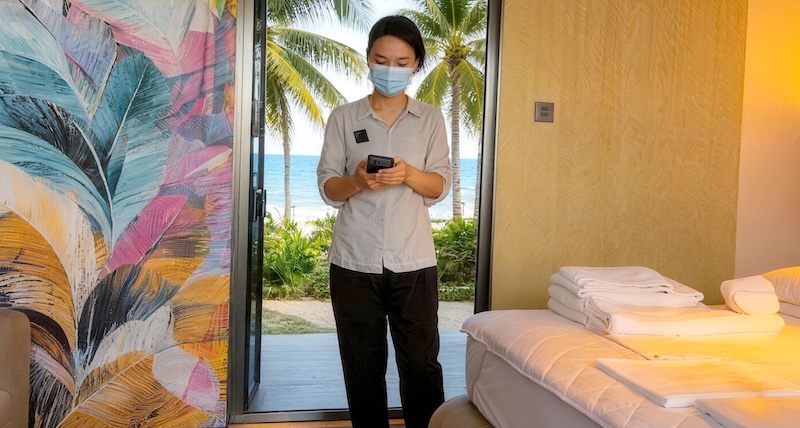
During periods of high occupancy at hotels, linen cycles accelerate as multiple item types are moving quickly across departments. Traditional manual counting and paper-based records often lead to low efficiency, delayed visibility, and unclear handover accountability.
To improve operational efficiency and enhance service quality, Marriott has adopted RFID technology in multiple areas, including linen management. This is significant as Marriott International is one of the world’s leading hotel groups, operating in 127 countries and regions with more than 6,500 hotels worldwide. In China, Marriott manages over 570 hotels.
The international hotelier introduced an RFID Linen Management System (SLMS) and deployed the Chainway MC51 built-in UHF handheld as the frontline operational device, enabling full-process digital management of hotel linens.
Challenges in Hotel Linen Management
Time-consuming counting and frequent manual errors is common issue that Marriott sought to rectify as high volumes and multiple SKUs make manual stocktaking inefficient and prone to missing items. Moreover, housekeeping records were complicated as after room cleaning, staff must manually record and compile reports, which is labor-intensive and not real-time.

Two other issues needed to be addressed: limited transparency in collection and outbound handover as discrepancies often occur between physical counts and records across collection, staging, and outbound handover. And long inventory checks make frequent cycle counts impractical and reduce inventory accuracy made warehouse stocktaking burdensome.
RFID Solution
To solve these issues, the project established a traceable, measurable, and verifiable closed-loop process by applying RFID tags to linens and scanning them at key hotel checkpoints. First was that washable RFID tags were sewn into linens such as bed sheets, towels, and bathrobes to provide item-level identification. Each item carries a unique RFID ID and can be tracked and analyzed by category, status, and location.
For processes inside the hotel, the solution covers the three major operational steps:
- Clean Linen Inbound Scanning (Receiving / Shelving). When clean linens arrive, staff use the MC51 built-in UHF handheld to scan linen carts or baskets in bulk. The system automatically records inbound receipt.
- Housekeeping Scanning (Issuing / Usage Confirmation). During housekeeping operations, staff scan linens with the MC51 to associate linen usage with specific floors or tasks, reducing manual recordkeeping.
- Dirty Linen Outbound Scanning (Collection / Outbound Handover). After dirty linens are collected and consolidated, staff perform bulk verification with MC51 before outbound handover. The system automatically summarizes quantities and categories, generating accurate outbound records and handover evidence.
MC51 Handheld Scanning
Chainway’s MC51 meets the key requirements of hotel linen management include high tag density, bulk scanning, fast speed, low missed-read rate, and device durability.
As the frontline operational terminal, MC51 has a built-in PCB antenna design that improves performance and ensures a lightweight, ergonomic handheld experience for high-frequency use. Powered by Impinj E Family reader IC and supports Impinj Gen2X, it delivers stronger efficiency and stability in dense multi-tag reading scenarios.
“Delivering strong RAIN RFID performance in a mobile form factor requires both great hardware and innovation,” said Vikas Dhurka, Senior Director of Product Management for Reader ICs at Impinj. “Powered by an Impinj E Family chipset and a built-in PCB antenna, Chainway’s MC51 leverages Gen2X to deliver faster, more accurate, and more consistent read performance in real-world RFID environments.”
Key for Marriott was high-performance multi-tag reading, which supports 750+ tags/second, ideal for rapid bulk counts on linen carts and baskets as well as being capable of reading 240 tags in 1 second with no missed tags, ensuring accurate inbound/outbound verification. Its Long read range reduces repeated close-range scanning and improves mobile counting efficiency with a 5000mAh removable battery with hot-swap / quick-swap support ensures uninterrupted operations throughout long working shifts.
Results & Business Impact
Based on the operations of a 200-room hotel with an average occupancy rate of around 80%, the RFID linen management system delivered significant efficiency improvements after deployment.
- Linen counting time reduced by approximately 90%: from 90 minutes to 10 minutes
- Housekeeping report recording time reduced by about 90%: from 90 minutes to 10 minutes
- Warehouse stocktaking time reduced by approximately 80%: from 5 hours to 1 hour
Marriott officials noted these improvements bring direct operational value, including faster counting that resulted in more timely linen dispatch during peak periods; a higher data accuracy giving improved consistency between physical inventory and system records; more automated reporting that results in minimized manual paperwork and missing entries; and clearer handover accountability, allowing for traceable responsibility for inbound/outbound movements.
Owen Wu, Deputy General Manager of Chainway, said the company “is committed to delivering high-performance RFID devices that can be reliably deployed across diverse industry environments. In hospitality scenarios such as hotel linen management, the MC51 demonstrates how strong multi-tag reading performance and operational reliability can translate into measurable efficiency gains and improved process visibility.”
By deploying the SLMS together with the Chainway MC51, Marriott successfully digitized and optimized key hotel linen operations including inbound receiving, housekeeping usage confirmation, dirty linen outbound handover, and warehouse stocktaking.
With measurable efficiency gains, the solution enables more stable, transparent, and efficient linen management in high-occupancy hotel environments.