
Nov 07, 2011In the Sierra Nevada, wireless sensor nodes are transmitting data indicating the amount of snow that has fallen or melted, as well as soil-saturation levels. Ultimately, all of this information can be used to calculate the volume of water available to the tens of millions of residents and businesses located downstream.
One step in achieving that goal is SierraNet—a program being run jointly by University of California (UC) researchers at the school system's Berkeley and Merced campuses. The first SierraNet project is taking place at the Kings River Experimental Watershed area, and is part of the Southern Sierra Nevada Critical Zone Observatory (CZO)—an environmental laboratory. The SierraNet projects are being led by Steven Glaser, a UC Berkeley professor of civil and environmental engineering, and Roger Bales, a UC Merced professor of engineering and the director of the Sierra Nevada Research Institute (SNRI). Glaser's team is now launching a much larger installation of wireless sensors, spread across the basin of the American River, with a $2 million grant from the National Science Foundation (NSF). The grant, awarded in September 2011, will be dispensed over the course of four years.
The American River installation will provide a much larger view into the movement of water originating in the Sierra Nevada, in order to help predict water supply downstream, where urban centers use the water that comes from this area. In fact, Glaser says, it will be the largest ecological wireless network in the world.
The Southern Sierra Nevada CZO project is a small part of an "Internet of Water" that researchers at four UC campuses—Berkeley and Merced, as well as Davis and Santa Cruz—are striving to create. The larger effort, officially known as the "Intelligent Water Infrastructures Initiative," intends to track the volume and flow of water in the mountains, aquifers and California's Sacramento-San Joaquin River Delta, and to make all of that data available to the public on the Internet, in real time.
Intelligent Water Infrastructures Initiative projects are supported by the Center for Information Technology Research in the Interest of Society (CITRIS), a multidisciplinary program that spans UC's Berkeley, Davis, Merced and Santa Cruz campuses, in addition to more than 60 industrial partners.
With the existing CZO, as well as other NSF-funded deployments, researchers are using active 2.4 GHz tags that communicate via a Dust Networks protocol that builds on the draft IEEE 802.15.4e standard for wireless personal area networks. Glaser is well familiar with the technology—he was part of the UC Berkeley team that developed it 10 years ago, ultimately leading to Dust Networks' establishment.
The CZO SierraNet project—located in Providence Creek, south of Shaver Lake, and about an hour west of Fresno—spans more than 1.5 square kilometers (0.6 square mile). The mesh network in place at that site includes a total of approximately 60 wireless sensor nodes (using data from a total of 300 sensors that capture data related to soil and snow) positioned up to 150 meters (492 feet) apart.
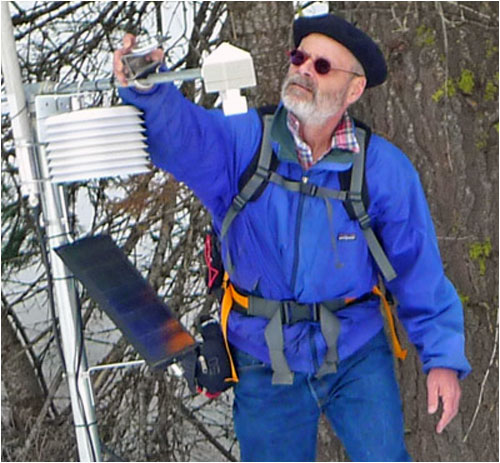
Each wireless node is built into a box mounted on a 12-foot-tall pole. The box contains a 2.4 GHz transponder, powered by an AA battery, a rechargeable gel-cell battery (to power the sensors) and a chip for storing sensor data. The sensors themselves are mounted to the same pole, or are buried in the surrounding soil. The underground sensors measure soil moisture, temperature and matric suction (a parameter that serves to indicate the amount of water available to plants). The pole-mounted sensors, placed at a height sufficient to remain above the snowpack itself, measure snow depth, temperature, solar radiation and relative humidity. The sensor battery is recharged by a solar panel mounted on an arm extending from the pole, on top of which is an antenna for transmitting data.
Every 15 minutes, each transponder transmits the sensors' measurements, along with its own unique identifier, via Dust Networks' Time Synchronized Mesh Protocol (TSMP), which builds on the draft 802.14.5e standard. That information is captured by adjacent transponders, located up to about 150 meters away, or by a "hopper"—a transceiver intended to forward data when the signal strength between transponders 'is not strong enough to forward those transmissions. The data is then sent to a gateway, installed on a central station attached to a 50-meter-tall (164-foot-tall) tower, above tree level. The gateway receives the information and utilizes a cellular connection to transmit it back to the researchers' software, on a server accessible via a computer or an Apple iPhone. The software stores and interprets the measurements, and researchers can view those results in order to determine details regarding the water and snowpack in the mountains.
In this case, Glaser says, each node's transponder will be embedded in a "brain board" that will enable researchers to remotely change instructions to any of the sensor systems, by transmitting data back to the transponder. Currently, he says, he is working on designing and implementing the brain board, as well as on improving the sensor hardware, such as determining the best location for wiring sensors to the transponder, and optimizing each mesh network's design layout. In addition, he says, "We'll be doing a fair amount of low-level programming," to improve on the software for the large volume of data that the system will generate. The researchers must also work with the U.S. Forest Service for authorization to install the technology on federal land.
Once the snow melts, in spring 2012, researchers and college students plan to install the nodes and sensors, which are expected to immediately begin collecting and transmitting data. The scientists anticipate sharing the information initially with the Sacramento Municipal Utility District, which will be able to use the information to optimize its strategy for operating local dams. The public and other entities will also be able to access the data via the SierraNet Web site.
In the long run, Glaser says, the research group intends to install sensor networks on other aquifers, in order to create a statewide system of calculating water volume so that those using the water can better plan their activities. When the statewide system would be in place has yet to be determined.
