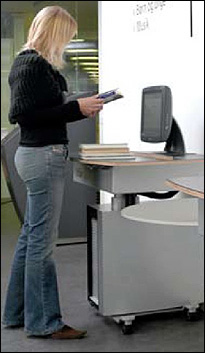
Hamburg Library Moves to RFID
The city’s central library and 17 branches will start deploying a system to manage the circulation of 2 million items per year. Patrons will check materials in and out themselves.

The city’s central library and 17 branches will start deploying a system to manage the circulation of 2 million items per year. Patrons will check materials in and out themselves.

The company is providing the systems free of charge to 3,000 U.S. retailers, making it possible for merchants to accept RFID-enabled credit cards.
Cell phone giant Motorola yesterday announced that it would buy Symbol Technologies for $3.9 billion, at a per-share price of $15. The purchase price represents roughly a 20% premium over Symbol’s closing stock price Friday afternoon, before rumors of the acquisition drove it up over the weekend.
The Fortune 100 firm has signed a definitive merger agreement, with a total value of approximately $3.9 billion, to buy Symbol Technologies, one of the largest suppliers of RFID hardware.
The project will use an ultrasound-based, indoor-positioning technology to track assets and patients, and radio frequency identification to manage the administration of drugs.
The mobile unit, designed for use on forklifts, has several potential applications for users of RFID technology.
Baird has released its September report. The 14-page document is a worthwhile read for anyone requiring an overview of the industry’s last 30 days. For those without time to do so, we have reprinted here the report’s summary.
U.S. and Hong Kong transit companies are using active tags to provide passengers with accurate information regarding bus locations and expected arrival times.
The International Technology Alliance, made up of 25 commercial and academic organizations, is chartered with helping the U.S. and U.K. militaries develop sensor-based technologies.

A European consortium is designing a system involving video cameras and battery-powered RFID tags to improve airport efficiency, security and passenger flow.